
Evaluating the impact of nature-based solutions
Appendix of Methods
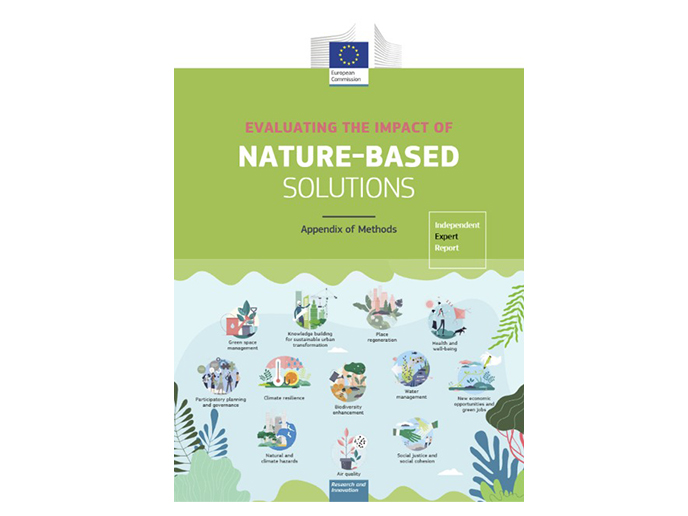
About this report:
Evaluating the Impact of Nature-based Solutions: Appendix of Methods is a compilation of methods of determination for indicators of NBS performance and impact. Experts in a wide variety of disciplines from eighteen EU H2020 NBS projects and a number of supporting European programmes were directly involved in the production of this Appendix of Methods, including (in alphabetical order):
- CLEARING HOUSE (H2020 Grant Agreement no.821242)
- CLEVER Cities (H2020 Grant Agreement no. 776604)
- CONNECTING Nature (H2020 Grant Agreement no. 730222)
- EdiCitNet (H2020 Grant Agreement no. 776665)
- Grow GREEN (H2020 Grant Agreement no. 730283)
- MAES (JRC-D3-Institutional project)
- NAIAD (H2020 Grant Agreement no. 730497)
- Nature4Cities (H2020 Grant Agreement no. 730468)
- Naturvation (H2020 Grant Agreement no. 730243)
- OPERANDUM (H2020 Grant Agreement no. 776848)
- PHUSICOS (H2020 Grant Agreement no. 776681)
- proGIreg (H2020 Grant Agreement no. 776528)
- RECONNECT (H2020 Grant Agreement no. 776866)
- REGREEN (H2020 Grant Agreement no. 821016)
- UNaLab (H2020 Grant Agreement no. 730052)
- URBAN GreenUP (H2020 Grant Agreement no. 730426)
- URBiNAT (H2020 Grant Agreement no. 776783)
It is part of the Handbook:
Evaluating the impact of nature-based solutions. A handbook for practitioners.
The Handbook aims to provide decision-makers with a comprehensive NBS impact assessment framework, and a robust set of indicators and methodologies to assess impacts of nature-based solutions across 12 societal challenge areas: Climate Resilience; Water Management; Natural and Climate Hazards; Green Space Management; Biodiversity; Air Quality; Place Regeneration; Knowledge and Social Capacity Building for Sustainable Urban Transformation; Participatory Planning and Governance; Social Justice and Social Cohesion; Health and Well-being; New Economic Opportunities and Green Jobs.
Indicators have been developed collaboratively by representatives of 17 individual EU-funded NBS projects and collaborating institutions such as the EEA and JRC, as part of the European Taskforce for NBS Impact Assessment, with the four-fold objective of: serving as a reference for relevant EU policies and activities; orient urban practitioners in developing robust impact evaluation frameworks for nature-based solutions at different scales; expand upon the pioneering work of the EKLIPSE framework by providing a comprehensive set of indicators and methodologies; and build the European evidence base regarding NBS impacts. They reflect the state of the art in current scientific research on impacts of nature-based solutions and valid and standardized methods of assessment, as well as the state of play in urban implementation of evaluation frameworks.
Connected to this report

Evaluating the impact of nature-based solutions: A Handbook for Practitioners.
Evaluating the impact of nature-based solutions A Handbook for PractitionersAbout this report: The Handbook aims to provide decision-makers with a comprehensive NBS impact assessment framework, and a robust set of indicators and methodologies to assess impacts of...

NAIAD: NAture Insurance value
NAIADValue of nature insurance: assessment and demonstrationNAIAD aims to operationalise “Natural Assurance Schemes”, defined as a range of schemes to internalise the insurance value of river systems. The NAIAD project aims to operationalise the insurance value of...
Authors
European Commission. Directorate-General for Research and Innovation
Contributing authors to chapters:
- Water management
- Natural and climate hazards
- New economic opportunities and green jobs
Citation
European Commission: Directorate-General for Research and Innovation, Dumitru, A. and Wendling, L. (eds), Evaluating the impact of nature-based solutions – Appendix of methods, Publications Office of the European Union, 2021, https://data.europa.eu/doi/10.2777/11361
Keywords
Nature-based Solutions
Water management
Biodiversity enhancement
Climate resilience
Participatory planning and governance
Green space management
Knowledge building
Urban planning
Place regeneration
Health and well-being
Green jobs
Economy
Social justice
Social cohesion
Air quality
Natural and climate hazards
Connected to this report
Evaluating the impact of nature-based solutions: A Handbook for Practitioners.
Evaluating the impact of nature-based solutions A Handbook for PractitionersAbout this report: The Handbook aims to provide decision-makers with a comprehensive NBS impact assessment framework, and a robust set of indicators and methodologies to assess impacts of...
NAIAD: NAture Insurance value
NAIADValue of nature insurance: assessment and demonstrationNAIAD aims to operationalise “Natural Assurance Schemes”, defined as a range of schemes to internalise the insurance value of river systems. The NAIAD project aims to operationalise the insurance value of...