
Water Resources Management in Surabaya river basin
About the project:
Application of Companion Modelling (ComMod) to support participatory water resources management and improve water quality in the Surabaya River Basin, Indonesia
The Surabaya River Basin, the most downstream and densely populated sub-basin of the Brantas River Basin in East Java, Indonesia, faces mounting water quality challenges driven by population growth, urbanisation, and industrial and domestic pollution discharged into the river. Weak platforms for stakeholder dialogue, low mutual trust between communities and authorities, and limited shared understanding of the water system have made it difficult to translate Indonesia’s legal commitment to public participation in water management into practice.
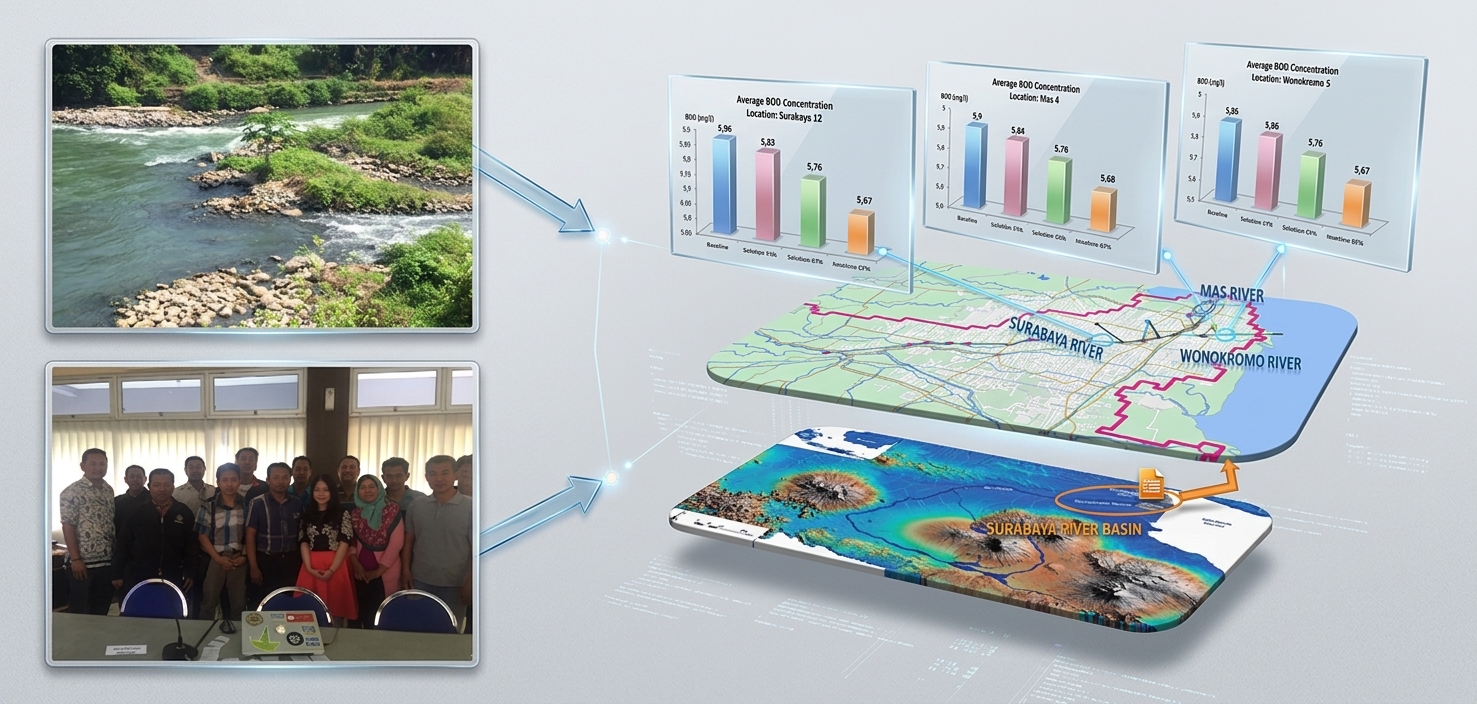
To address these challenges, the project developed and applied a Companion Modelling (ComMod) approach tailored to the Surabaya context, combining a role-playing game with the RIBASIM river basin simulation model and the Negotiated Approach, a participatory methodology for empowering local communities in water resources management. This combination enabled local communities, factories, NGOs, and water management authorities to exchange perceptions, co-construct a shared understanding of the river system, and negotiate and evaluate potential measures to improve water quality together.
The project contributed to strengthening evidence-based, inclusive basin planning by:
- Facilitating role-playing game sessions that brought together local communities, factories, NGOs, and water authorities to build a shared understanding of the Surabaya River system and its water quality dynamics.
- Integrating the RIBASIM simulation model with participatory tools to represent the basin’s hydrological dynamics and support decision-making on water quality improvement measures.
- Applying the Negotiated Approach to strengthen local communities’ involvement in water resources planning through a transparent and equal process.
- Evaluating measures proposed by stakeholders, including wastewater treatment interventions, to assess their impact on reducing pollution and improving river water quality.
- Generating lessons and a classification framework to guide the future application of collaborative and participatory modelling approaches in Integrated Water Resources Management.
Implementation Period
2015 – 2017
Partners
- Delft University of Technology
- ECOTON
- KLH
Donor
Countries
 Indonesia
Learn More
Publication
-
Stakeholder Partnerships: Collaborative Modeling as a Mechanism for Sustainable Development